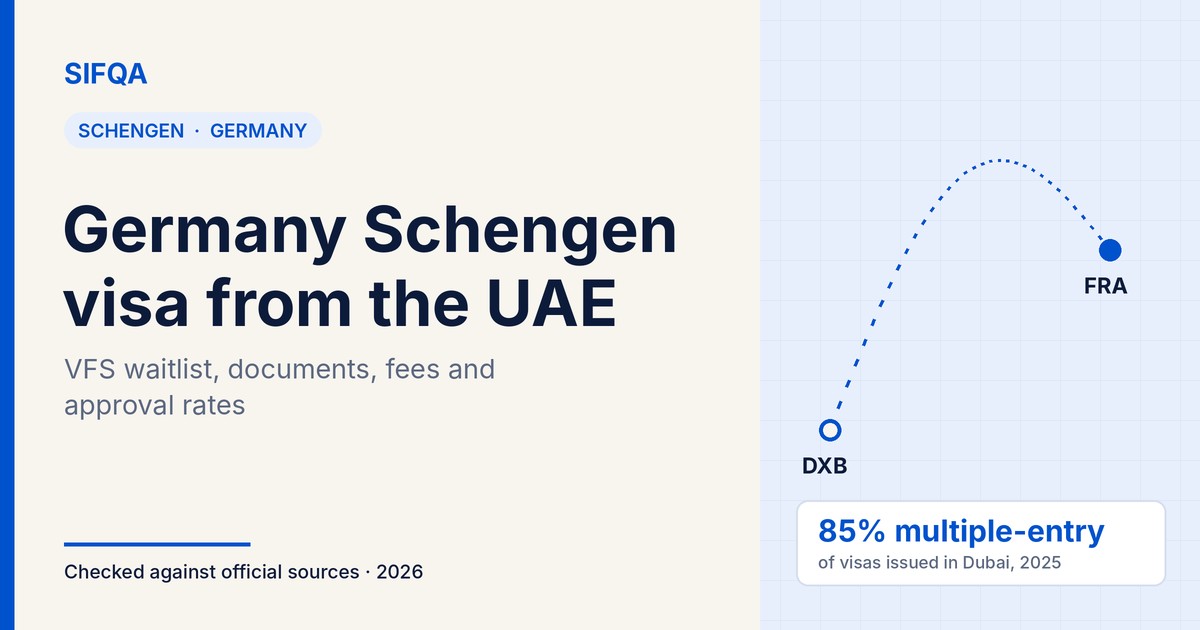
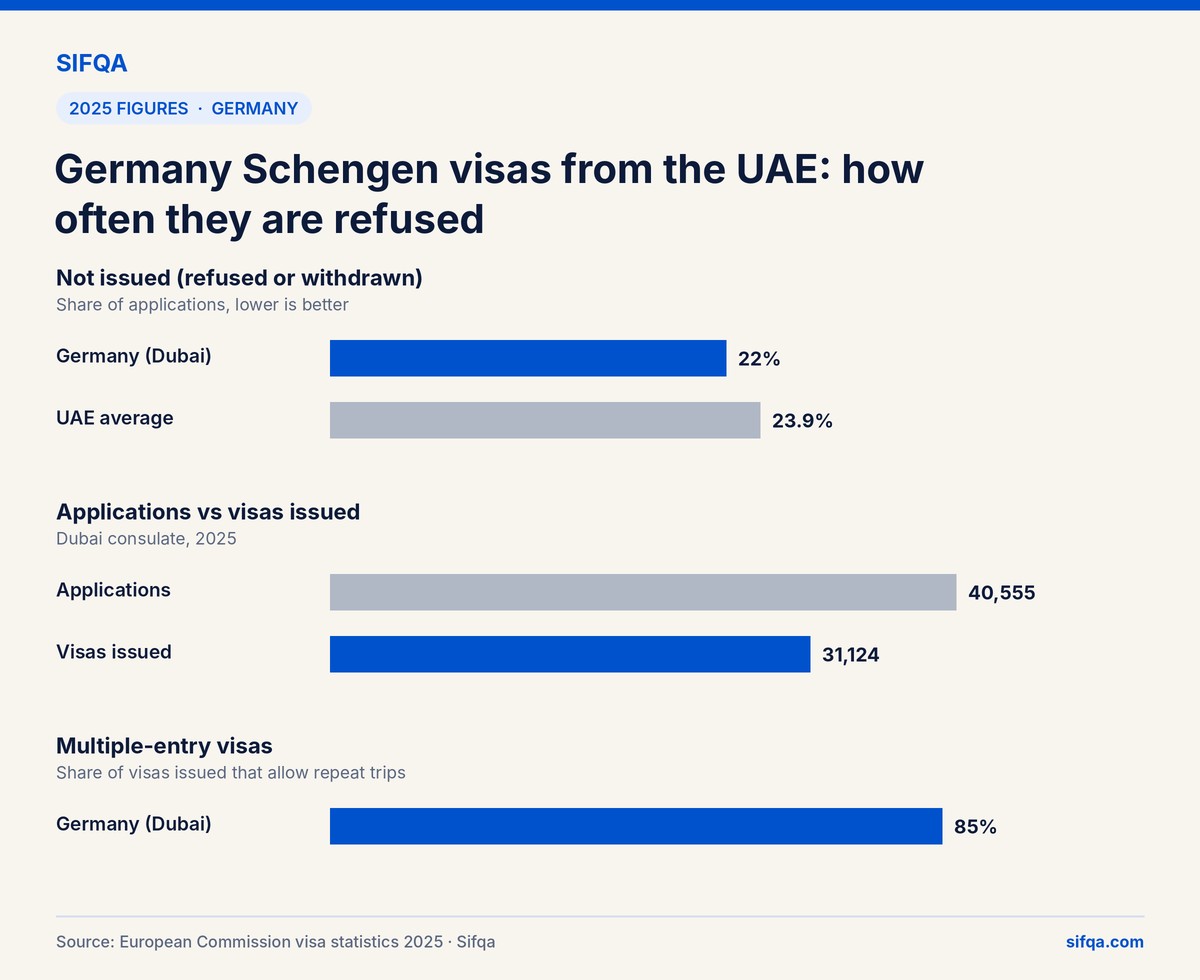
Germany is the Schengen country UAE residents apply to most. In 2025 the German Consulate General in Dubai received 40,555 short-stay applications — more than any other Schengen consulate in the country — and 85% of the visas it issued were multiple entry, the highest share of any large consulate here. The hard part is not the decision but the appointment: Germany books slots through a VFS Global waitlist, and you need to know how it works to get one.
Checked on 20 October 2026 against the German Missions in the UAE, the European Commission’s 2025 visa statistics and the EU Visa Code. Sources at the end.
On this page
- Germany at a glance
- When Germany is the right country to apply to
- Where you apply: your emirate decides
- How the VFS waitlist works
- Step by step
- Documents and money
- What the 2025 figures say
- If you are refused
- Questions people ask
Germany at a glance
| Who decides | German Consulate General, Dubai (all UAE applications) |
| Where you submit | VFS Global — Dubai or Abu Dhabi, depending on your emirate |
| Application form | VIDEX online form, printed and signed |
| Visa fee | €90 adults, €45 children 6–11, free under 6 — paid in AED |
| VFS service fee | Charged on top by VFS |
| Decision time | Up to 15 days after your appointment |
| Apply | Up to 6 months before travel; join the waitlist early |
| 2025 not-issued rate | 22% (UAE average 23.9%) |
| Multiple-entry share | 85% of issued visas |
Emirati passport holders do not need a Schengen visa for short trips. This guide is for UAE residents whose passport requires one — Indian, Pakistani, Filipino, Egyptian, Bangladeshi, Sri Lankan, Nigerian and many others.
When Germany is the right country to apply to
You apply to Germany only if Germany is your main destination: the country where you spend the most nights, or where the main purpose of your trip is. If the nights are equal across countries, you apply to the country you enter first. This is Article 5 of the EU Visa Code, and the Consulate checks your bookings against it.
Example: four nights in Munich, two in Salzburg, two in Prague. Germany has the most nights, so you apply to Germany. Applying to a country only because its slots are easier to find is a common reason for refusal. Our guide on which Schengen country to apply to covers the harder cases.
Where you apply: your emirate decides
| Your residence visa was issued in | Submit at |
|---|---|
| Dubai, Sharjah, Ajman, Umm Al Quwain, Ras Al Khaimah, Fujairah | VFS Global Dubai |
| Abu Dhabi, Al Ain | VFS Global Abu Dhabi |
Both centres send files to the same visa section in Dubai, so the decision is made by the same officers wherever you submit. Germany works only with VFS Global in the UAE. Nobody else can book or submit for you.
Spouses of German or EU citizens, and parents of minor German or EU citizens, who live in the UAE may submit without an appointment.
How the VFS waitlist works
Germany does not show an open calendar. Instead:
- You register on the VFS Global Germany UAE site and join the waitlist in the right category: Short Stay (tourism and family visits) or Business.
- When slots are released, VFS emails registered applicants in the order they joined.
- The email offer is valid for 24 hours. If you miss it, the slot goes to the next person.
Three practical rules follow from this. Join the waitlist as soon as you know your dates — up to six months ahead. Check your spam folder daily. And book the right category: a tourism trip booked as Business can be turned away at the counter.
Anyone selling a “guaranteed” German appointment on WhatsApp is not connected to VFS or the Consulate. See how Schengen appointment scams work.
Step by step
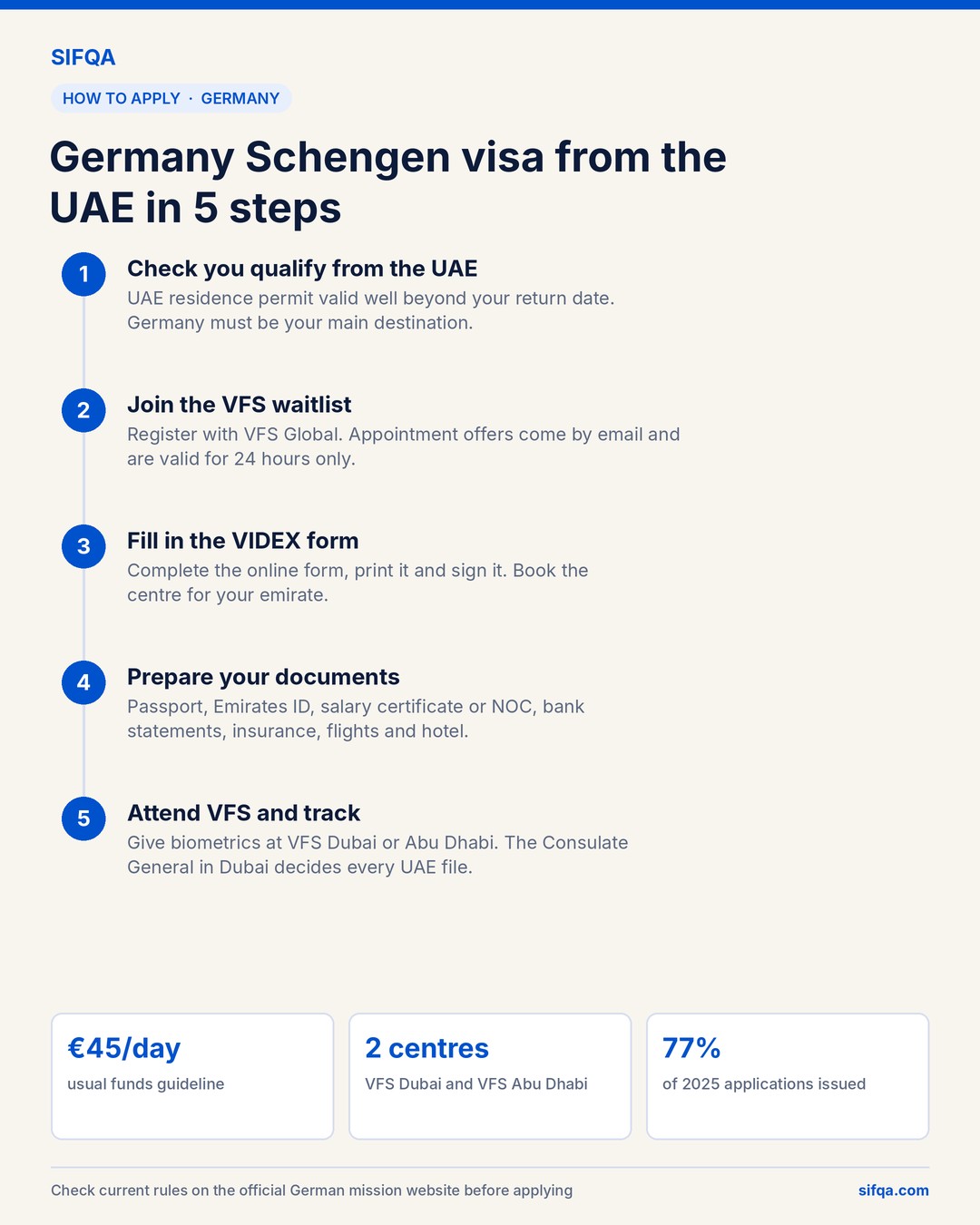
- Confirm Germany is your main destination.
- Join the VFS waitlist in the correct category.
- Fill in the VIDEX short-stay form online (English or German), print it and sign it.
- Download the Consulate’s checklist for your purpose — tourism, family visit, business or trade fair — and build your file in that order.
- Accept the appointment offer within 24 hours.
- Attend in person. Fingerprints are taken unless you gave them for a Schengen visa in the last 59 months. Children under 12 are exempt.
- Pay the visa fee in AED and the VFS service fee.
- Track the application and collect your passport, or have it couriered.
Documents and money
Use the Consulate’s own checklist. A typical tourism file from the UAE contains:
- Passport issued in the last 10 years, valid 3 months beyond your return, with two blank pages.
- UAE residence visa and Emirates ID, with enough validity after your return.
- Signed VIDEX form and one biometric photo.
- Employer letter or NOC with salary, start date and approved leave. See our NOC templates.
- Bank statements, usually for 3 to 6 months, stamped by the bank. See our bank statement guide.
- Flight reservation and hotel bookings matching your dates.
- Travel medical insurance: at least €30,000, valid in all Schengen states for your whole stay. See our insurance guide.
How much money to show
Germany sets no fixed legal figure. The Foreign Office’s guideline is at least €45 per person per day on top of your flights and accommodation. A 10-day trip for one person therefore needs about €450 of spending money, plus the cost of hotels and flights. In practice, a steady salary credit and a balance that comfortably covers the whole trip matter more than the minimum. See bank balance for a Schengen visa.
If someone in Germany is paying for your stay, they can sign a formal obligation (Verpflichtungserklärung) at their local foreigners’ office. It replaces your own proof of funds.
What the 2025 figures say
| German Consulate, Dubai (2025) | Figure |
|---|---|
| Applications | 40,555 |
| Visas issued | 31,124 |
| Not-issued rate | 22% |
| Multiple-entry share of issued visas | 85% |
Germany’s refusal rate is close to the UAE average, but its multiple-entry share is exceptional: most approved applicants receive a visa valid for more than one trip. If you have a clean Schengen travel history, ask for multiple entry on the form and say why. Full numbers for every consulate are in our Schengen statistics for the UAE.
If you are refused
The refusal letter ticks the reasons from a standard EU list — for example, doubts about your intention to return, or insufficient funds. Read them carefully. You then have two routes:
- Reapply with a file that answers the stated reasons. For most refusals this is faster.
- Challenge the decision by the route and deadline written in the refusal letter.
See our Schengen refusal and appeal guide.
Mistakes to avoid
- Waiting for a confirmed itinerary before joining the waitlist.
- Booking the Business category for a holiday.
- Applying to Germany when most nights are in another country.
- A large cash deposit just before the bank statement is printed.
- Insurance that starts after your flight lands.
Questions people ask
How long does a German Schengen visa take from Dubai?
Up to 15 days after your appointment. The wait for the appointment itself is usually the longer part, so join the waitlist early.
I live in Abu Dhabi. Can I apply in Dubai?
No. Abu Dhabi and Al Ain residents submit at VFS Abu Dhabi. Dubai and Northern Emirates residents submit at VFS Dubai.
Does Germany give multiple-entry visas to UAE residents?
Often. In 2025, 85% of the visas issued by the German Consulate in Dubai were multiple entry.
How much bank balance do I need for a German visa?
There is no fixed legal amount. The guideline is €45 per person per day on top of travel and accommodation costs, backed by regular income.
Related guides
- Schengen visa from Dubai and the UAE
- Schengen visa checklist for UAE residents
- Schengen visa appointments in the UAE
- Germany Opportunity Card and EU Blue Card from the UAE
Sources
- German Missions in the UAE — Schengen visa: uae.diplo.de
- European Commission — Visa statistics for consulates, 2025 (published 28 May 2026)
- EU Visa Code, Regulation (EC) No 810/2009 — Article 5 (competent state) and Article 15 (insurance)
- Federal Foreign Office (Auswärtiges Amt) — means of subsistence guideline for short stays
Written by Asad Waleed M, Dubai. Asad has lived in the UAE for nine years and researches visa rules from government sources. He is not an immigration lawyer or consultant, and Sifqa does not process applications. Read the editorial policy.
Last checked 20 October 2026. Rechecked quarterly and when the Commission publishes new statistics. Found an error? Email ionicwaleed@gmail.com — it gets fixed and logged.